Portable Magnetic Gym Timer, Black
mounting Magnet + standcontrol Remote included
$32.29
Guide
A phone can time a workout. It cannot be read across a garage, it cannot be started with chalk on your hands, and it will ring in the middle of the third round because somebody has replied to a message.
That is the whole case for a dedicated timer, and it is the reason this department exists. What follows is what we have learned building five of them, including the complaints that changed the design.
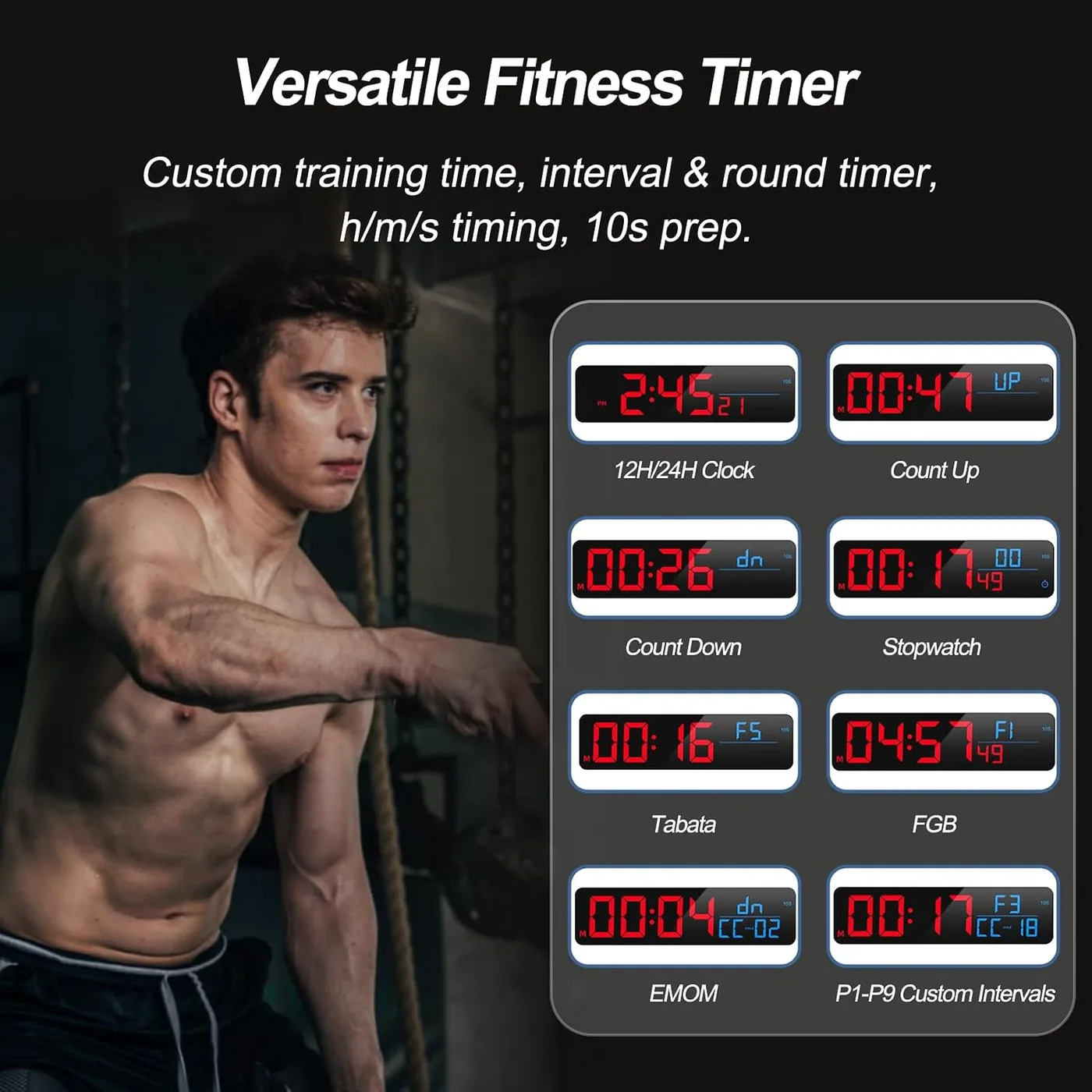
Interval training is a family of formats rather than one thing, and they ask different questions of a clock. A timer that handles one of them well can be useless for another.
| Format | Structure | What the timer must show | Where cheap timers fail |
|---|---|---|---|
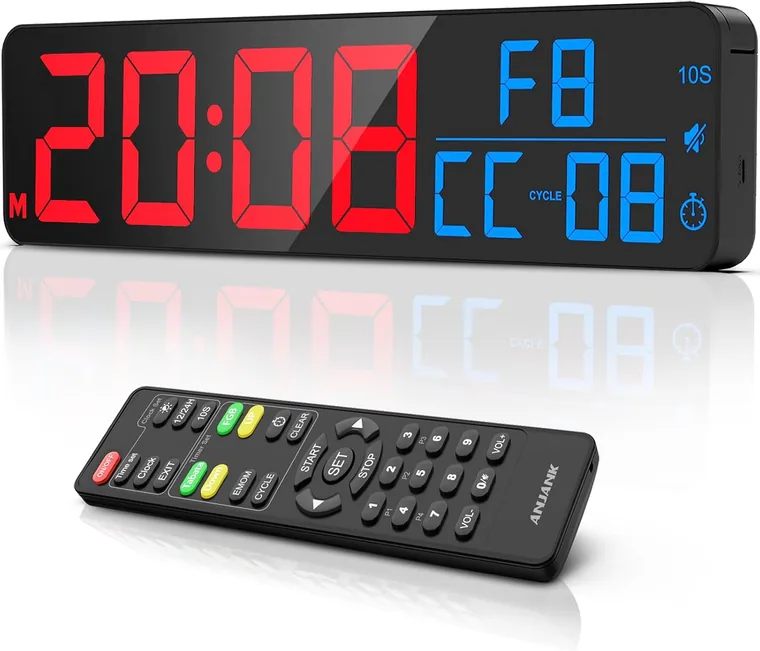
| Tabata | 20 seconds work, 10 rest, 8 rounds | Seconds and round number | No round counter |
| EMOM | One set at the top of every minute | A minute that resets by itself | Needs restarting each round |
| AMRAP | As many rounds as possible in a window | One long count-up or down | Beeps at every minute |
| Rounds and rest | Work, rest, repeat, custom lengths | Two independent intervals | Only one editable interval |
| Fight Gone Bad | Five stations, one minute each, one rest | Station number and clock | No station display |
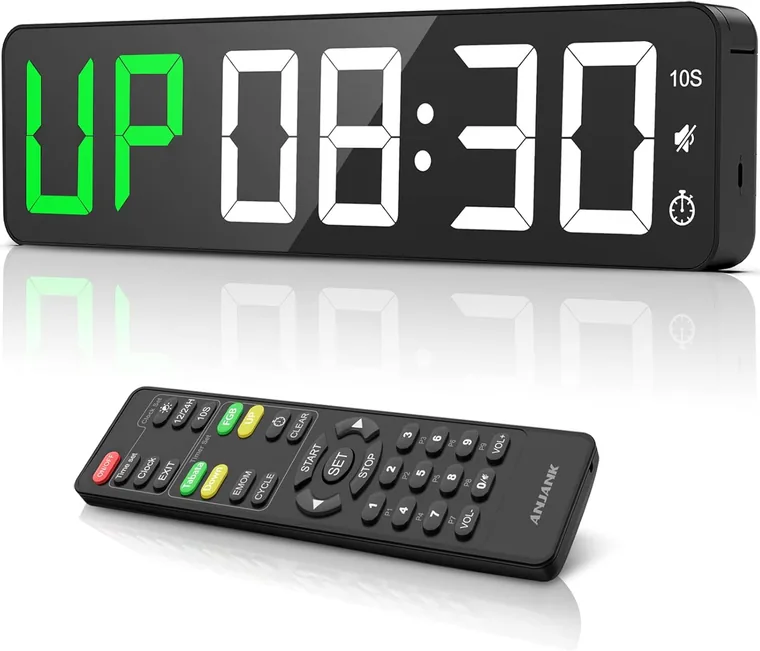
| Simple stopwatch | Start, stop, read | Large digits, nothing else | Buried in a menu |
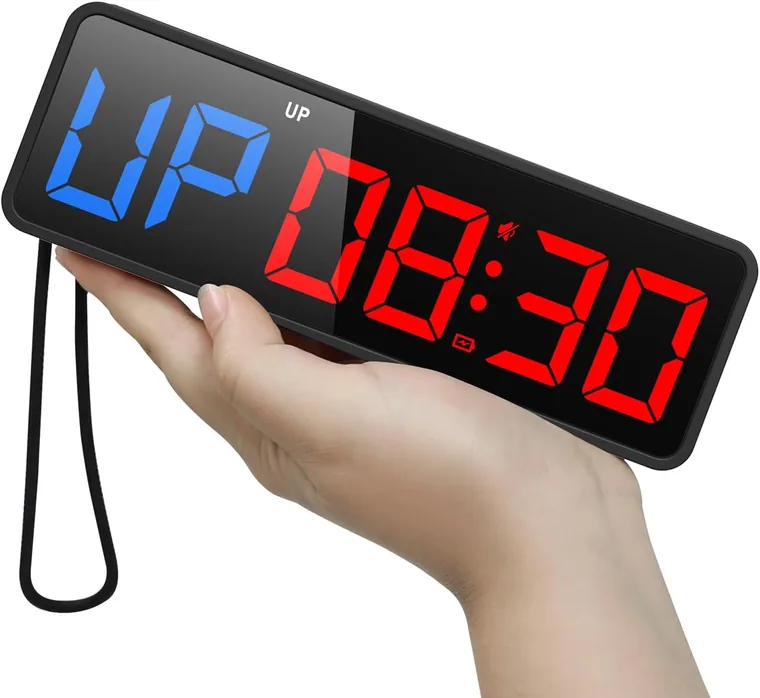
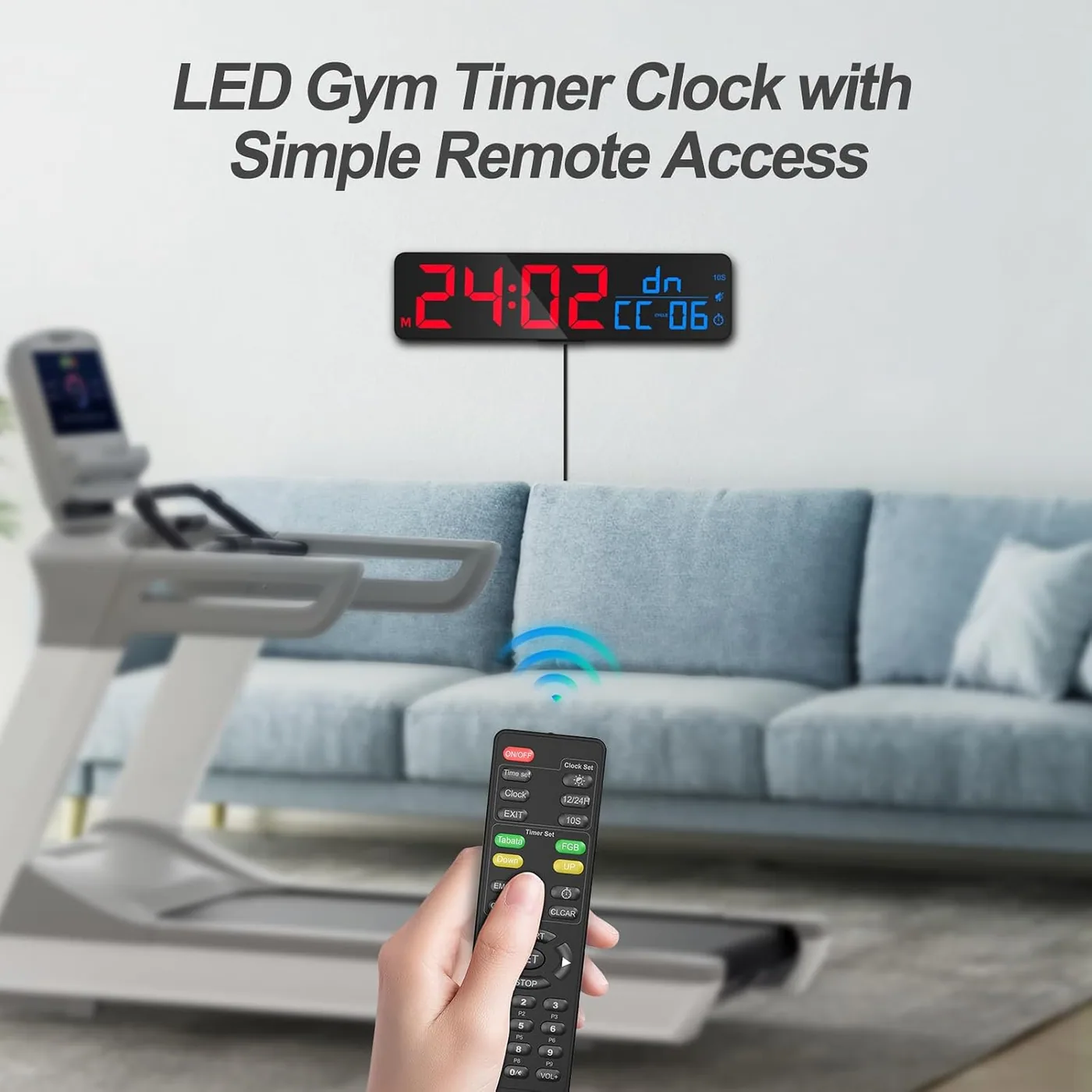
Our 15-inch timers cover all six, with nine programmable plans for the combinations that do not have names. The portable timer covers the same ground on a smaller display.
Almost everybody starts with a phone, and almost everybody stops. The reasons are boring and they are all about the room rather than the software.
A phone screen is four inches of glass held at arm's length. Put it on the floor beside a bench and the digits vanish at the moment you are upside down under a bar. Wake locks fight the screen timeout, notifications interrupt, and a call in the middle of a set ends the round for you.
There is also the physical problem. Chalk, sweat and a touchscreen do not agree, and the one control you need mid-workout is the one that needs a clean fingertip. A remote with real buttons solves that in a way no app can.
The single most useful number on a gym timer is the height of a digit, because that is what sets the distance at which the clock still works. A rough rule from signage holds up well in a gym: about one inch of character height for every ten to twelve feet of reading distance, in good light.
| Digit height | Comfortable distance | Fits |
|---|---|---|
| 0.6 in (a watch) | Arm's length | Nothing beyond your own wrist |
| 1.3 in (portable timer) | 10 to 15 ft | A rack, a mat, a home corner |
| 2.6 in (15-inch panel) | 25 to 30 ft | A two-car garage, a studio, a class |
| 3.2 in (11-inch scoreboard) | 30 to 35 ft | A driveway court, a hall, a table tennis room |
Those distances assume indoor light and a dark background behind the display. Sunlight cuts them hard, and colour matters as much as size, which brings us to the complaint we get most.
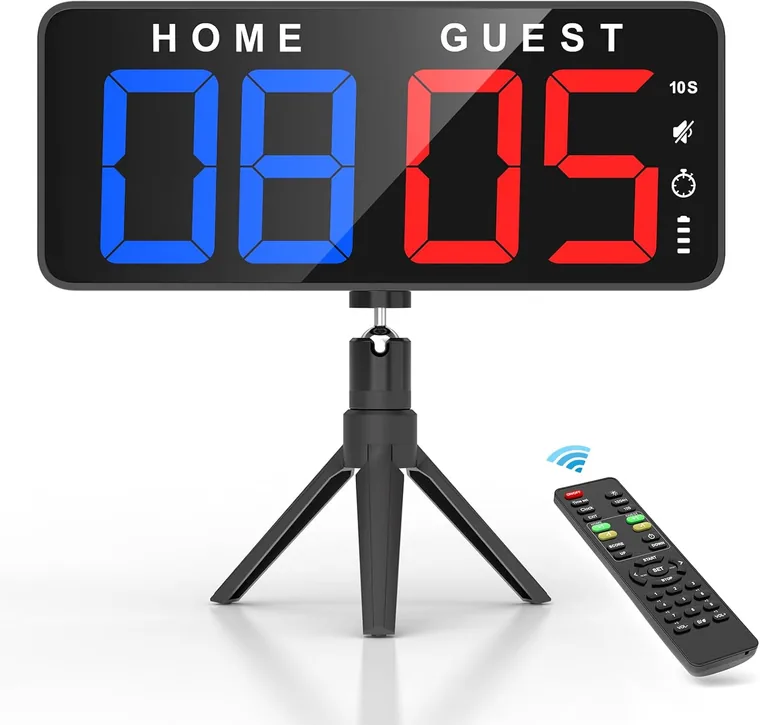
Our 11-inch scoreboard shows the home score in blue and the guest score in red. Indoors that reads well and looks good. Outdoors in daylight, blue loses against a bright sky, and owners have told us so:
The only problem, and it makes it very hard to use, is that the blue digits are not very visible unless you are standing right next to it.
We have not hidden that review and we are not going to. If your games happen on a driveway at two in the afternoon, this scoreboard is the wrong purchase, and a red or green display is the right one. In a hall, at dusk, or under lights, it is a different device. The full department page says the same thing above the photographs.
The general lesson is worth keeping. Red and amber survive daylight best, green is next, and blue is the first to go. Any LED display you are buying for outdoor use deserves that question before the feature list.
Digit size sets the distance and brightness decides whether that distance survives the room. Five steps of brightness is not a luxury on a device that has to work in a dim basement and a garage with the door open.
The mistake people make is running a timer at full brightness indoors. At night, in a small room, a maximum-brightness LED panel leaves an after-image every time you look up, and the timer becomes harder to read rather than easier. Two steps down is usually the right answer inside.
Outdoors the opposite is true and the ceiling is the display itself. No LED panel in this price class wins against direct sun. Shade, an awning or the north side of a building will do more for readability than any setting on the remote.
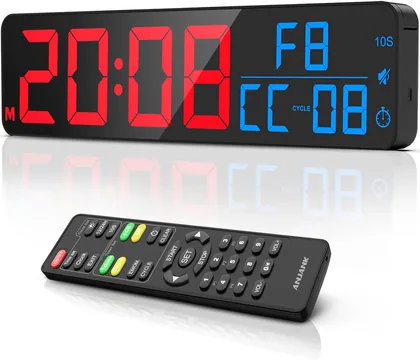
A visual timer still needs a beep, because nobody watches the clock during the last five seconds of a set. Our 15-inch timers put out a 110 dB alert with twelve volume steps, and the portable timer is quieter by design.
Twelve steps sounds like a marketing number and is not. A timer in a home garage at six in the morning and a timer in a class of twenty people need completely different settings, and a device with three steps will be wrong for one of them.
I work out in the early morning when everyone is asleep - the noise level is as desired.
It is also worth remembering what those decibel figures mean over a long session. NIOSH sets the workplace yardstick here:
NIOSH established a recommended exposure limit (REL) of 85 A-weighted decibels (dBA) averaged over an eight-hour workday.
National Institute for Occupational Safety and Health, Noise and Hearing Loss, read 30 August 2026
A short beep every twenty seconds is not an eight-hour exposure, and a gym timer is not a hazard. But a coach running six classes a day beside a timer set to maximum is closer to that yardstick than they think, and turning it down two steps costs nothing.
Where the timer goes decides whether it gets used. Four mounting routes cover almost every room, and our 15-inch panels support all of them.
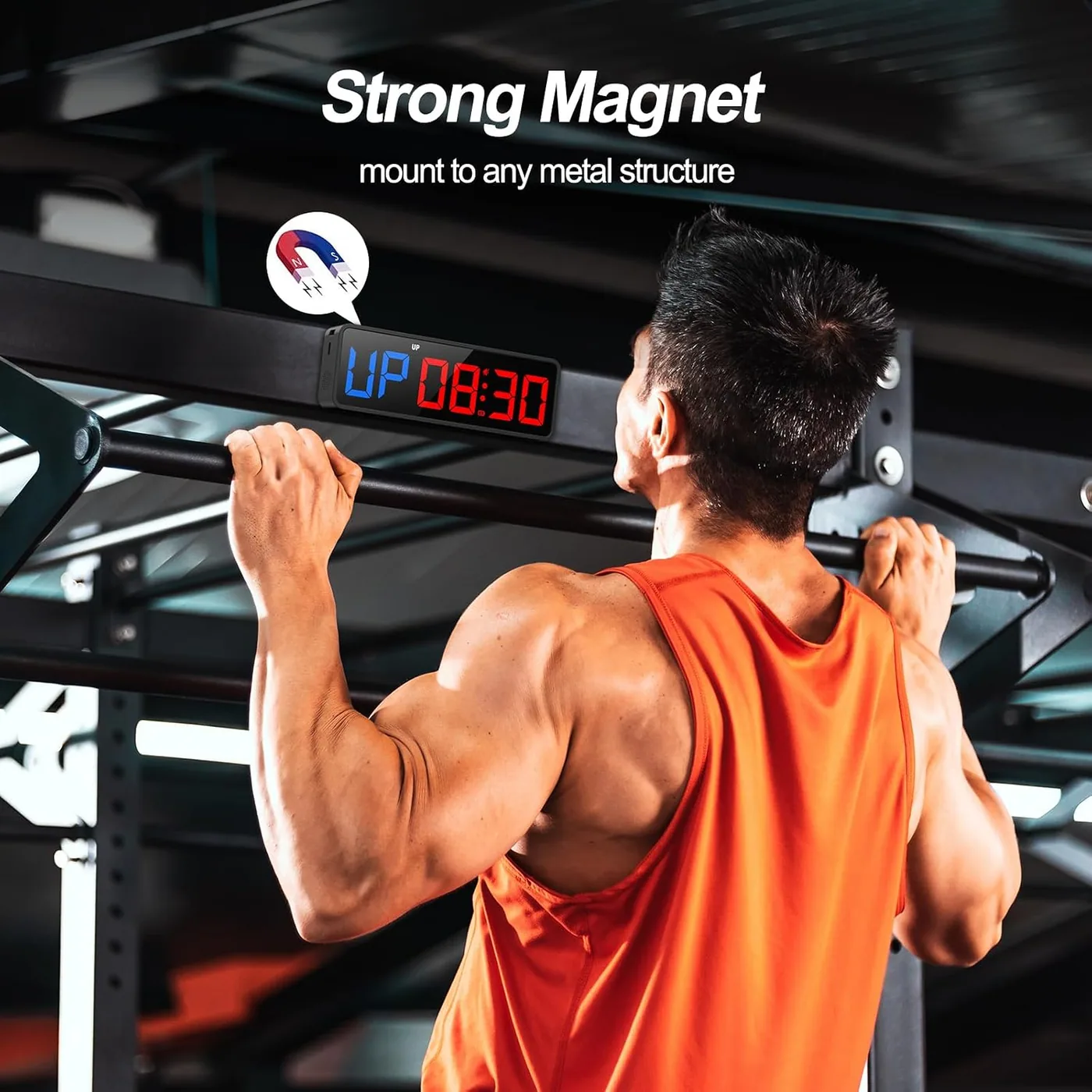
The magnet is stronger than people expect and weaker than powder-coated steel sometimes suggests. If a timer slides down a rack, the surface is thin or painted heavily rather than the magnet being weak, and a screw or a tie solves it in a minute.
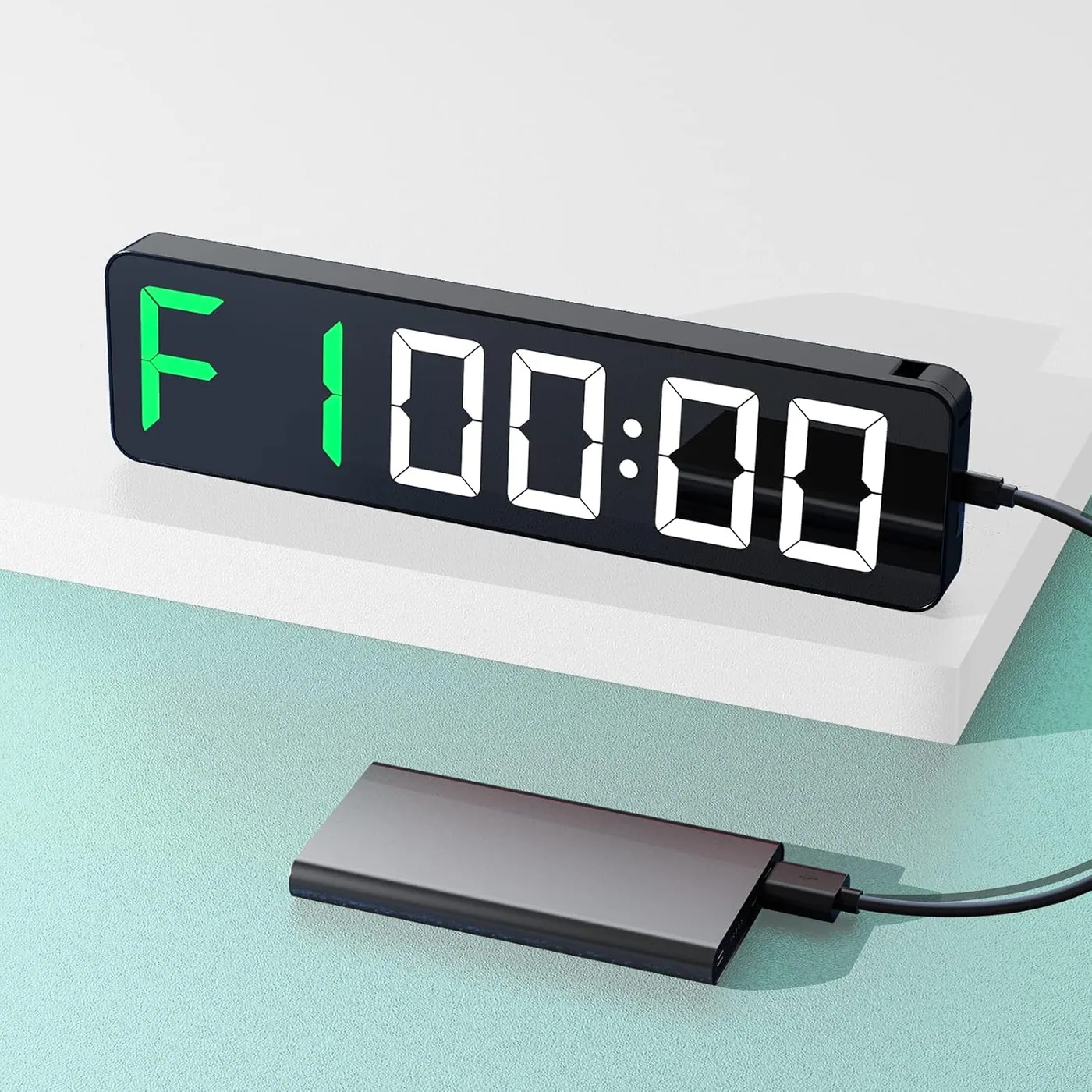
A timer on a wall wants mains power and never thinks about it again. A timer that travels wants a battery. Our range splits along that line.
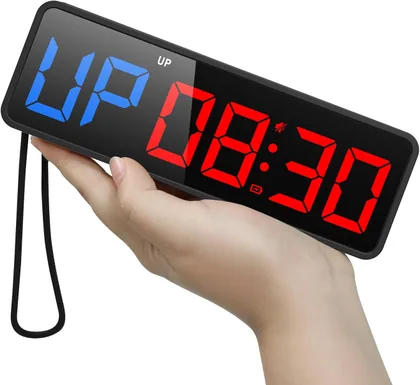
The 15-inch panels run from a DC adapter with a 9.2 ft cable, and they will also run from a USB-C power bank, which is what makes them usable at a park or on a field. The scoreboard carries its own cell and gives about 25 hours of use. The portable timer is rechargeable, and owners regularly report months between charges because it spends most of its life switched off.
One warning that belongs in the open. The coin cell inside the 15-inch timers holds settings, not the clock, and it is not included. If your timer forgets a custom plan after a power cut, that cell is the first thing to check.
The sharpest criticism we have had of a timer came from a coach, and it was correct.
My biggest issues are the 10 second starting timer and a lack of a pause feature, which I use frequently for myself and my clients.
The 15-inch models start with a ten second lead-in and have no mid-round pause. For a solo session that is invisible. For a trainer who stops to correct a client's form four times in a round, it is the difference between a tool and an obstacle.
We print this on the department page as well, because there is no version of this complaint that gets solved by a better photograph. If you coach, use the portable timer, which starts and stops in one press, or plan the session so that stops fall between rounds.
Specification sheets in this category are written to be compared, so they list what is easy to count: modes, volume steps, mounting holes. Three things that decide daily use rarely appear at all.
Refresh behaviour is the first. A display that flickers on camera is fine to the eye but ruins any video of a session, and anybody filming lifts will notice within a week. The second is the lead-in: a fixed ten second countdown before every start is a feature for a class and an irritation for a solo session.
The third is what the timer does when a round ends. Some panels hold the last number, some blank, some roll straight into the next interval. None of that is printed anywhere, and all of it changes how the device feels to use.
Most people programme a timer once and then use the same plan for a year, so it is worth spending ten minutes on that first setup. Three plans cover most training.
The first is a warm-up count-up, ten minutes, no beeps in the middle. The second is the working interval, whatever your format is, with the round counter on. The third is a rest-day plan with long intervals for mobility work, because otherwise nobody ever does mobility work.
Store them as P1, P2 and P3 on the remote and the timer becomes a three-button device, which is what it should be while your hands are chalky.
A garage gym in a family house has a second set of constraints, and they are social rather than technical. Six in the morning is the most popular time to train and the worst time to make noise.
Three things help. Turn the alert down to the lowest step that you can hear over your own breathing, which is usually far lower than the default. Mount the panel where the light does not spill into a hallway. And use a count-up plan for the warm-up so nothing beeps for the first ten minutes, while the rest of the house is still asleep. Waking that early has its own guide.
The owner review we quote above says the same thing in one line, and it is the most common piece of feedback we get from people training at home before work.
Every timer here ships with a remote, and the remotes work through walls. That is convenient at home and awkward in a gym with two units in adjacent rooms, where one remote can change both.
Our own description of the scoreboard says so plainly, and the workaround is boring: one device per space, or pair them so the units are far apart. If you are equipping a club with six timers in one hall, this is the question to ask before the order, not after it.
A timer is a tool for structure, not a training plan, and the amount of training that needs structuring is smaller than gym culture suggests. The CDC puts the target for adults in two lines:
Adults need at least 150 minutes of moderate-intensity physical activity a week, such as 30 minutes a day, 5 days a week.
Centers for Disease Control and Prevention, Physical Activity Guidelines for Adults, read 30 August 2026
Adults also need 2 days of muscle-strengthening activity each week.
Centers for Disease Control and Prevention, Physical Activity Guidelines for Adults, read 30 August 2026
Thirty minutes, five days, plus two sessions of strength work. A twenty-minute interval session at the right effort is a large piece of that, and a timer on the wall makes the difference between doing it and meaning to.
It is also the argument for buying the cheap end of this department first. A portable timer at the price of two takeaway meals will tell you inside a month whether interval training is something you keep doing.
An LED panel has few ways to fail. The segments outlive the owner in normal use, and what goes wrong is almost always at the edges: a barrel connector that has been pulled sideways once too often, a remote with a flat cell, or a coin cell that lost the stored plans.
That shapes how to look after one. Route the power cable so a foot cannot catch it, keep a spare CR2032 in the drawer with the remote, and write your interval plans on a card taped to the back of the panel. Ten minutes of setup you can redo from the card is worth more than any warranty.
One owner reported a timer that stopped after five weeks and a new battery did not revive it. That is a defect rather than wear, and it is the case where the retail partner's return window matters more than anything on this page.
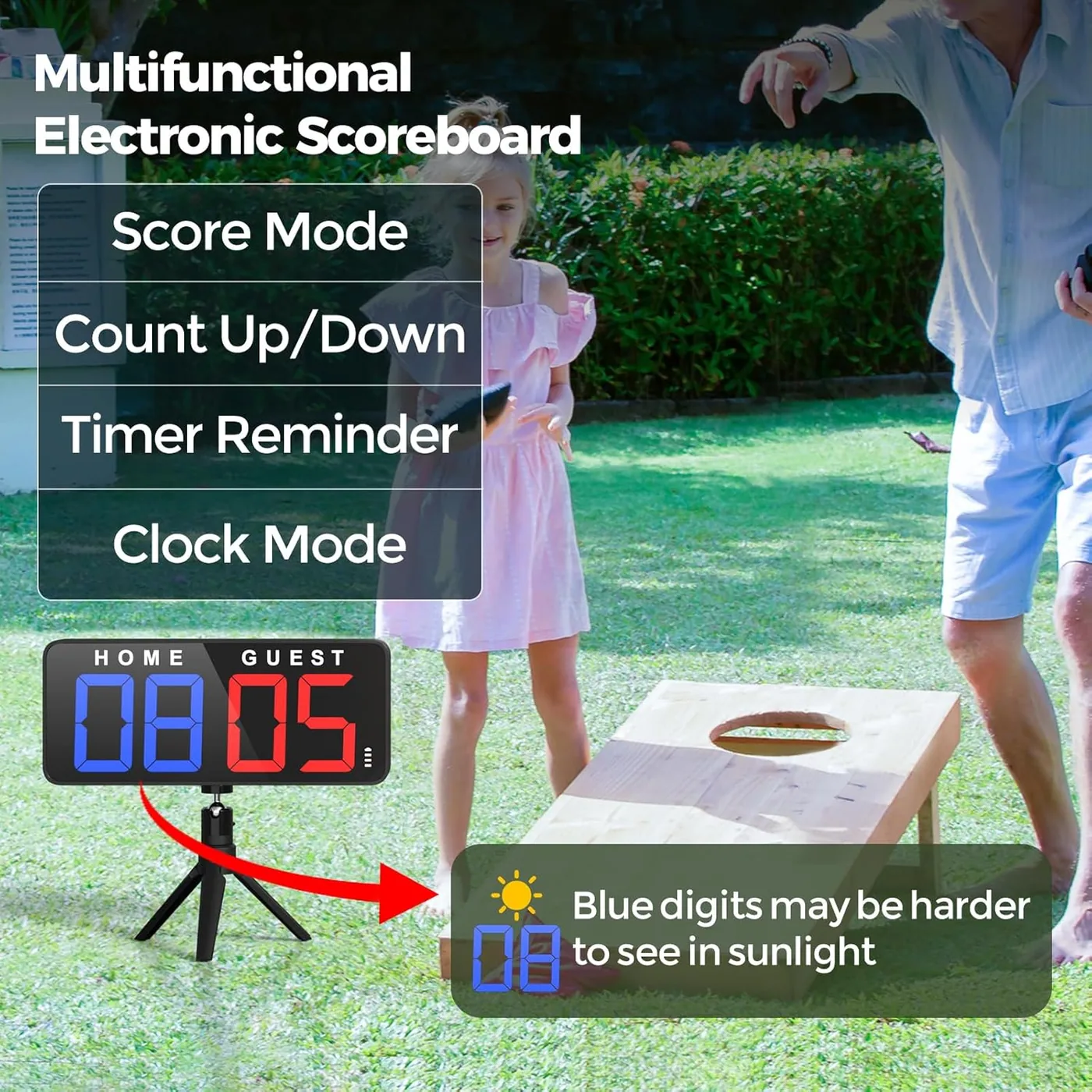
Half the people who buy our 11-inch board are not training at all. They are counting cornhole, table tennis, a driveway basketball game or a class competition, and what they want is a number everybody can see and a remote that a child can press.
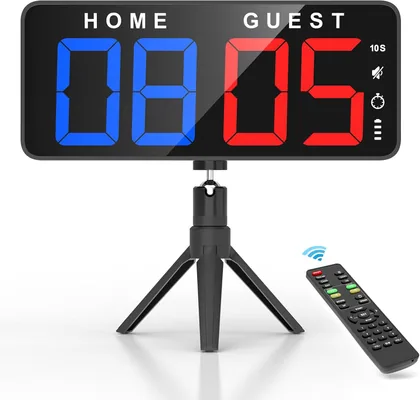
For that job the board is straightforward: home and guest digits, count up or down, a timer mode, a clock mode, four mounting routes and an IPX4 rating for splashing. It is rated for a wet afternoon, not for a downpour.
The pair we sell, the scoreboard together with a 15-inch timer, exists because clubs kept buying both. If you are running games and training in the same hall, that is the sensible order rather than two separate purchases six months apart.
A useful share of our timer owners are not athletes. Teachers time oral presentations with them, and one owner told us a fifth-grade classroom was the whole reason for the purchase. Kitchens, workshops, music practice and physiotherapy show up in reviews as well.
The requirement is the same in all those rooms: a number big enough to read from wherever people sit, a beep that can be turned down, and controls that a person other than the owner can work out in a minute. A bedside clock is the opposite brief, and the sound machines take that end of it.
It also explains why the clock mode matters. A timer that shows the time when it is not counting anything stays on the wall. A timer that shows nothing gets put in a cupboard between sessions and then forgotten.
Before ordering anything, walk to the spot where you actually stand during the hardest part of a session and measure the distance back to the wall the timer will hang on. Most people guess low by a third, because a garage feels smaller than it is when you are standing in the middle of it.
Then take the table above and pick the panel one step larger than that distance suggests. Digits that are bigger than necessary cost a few dollars. Digits that are too small cost the whole purchase.
Buy for the room. A home corner needs the portable timer and nothing else. A garage with a rack wants a 15-inch panel on the wall where it is visible from the floor. A hall with games in it wants the scoreboard, and a hall with games in daylight wants a red display, ours or anyone else's.
And keep the plan simple. Three stored programmes, one volume setting you can live with, and a clock that reads from where you actually stand. That is the whole job.
If the hard part of the morning is getting up for the session at all, the guide to waking a heavy sleeper covers vibration, light and distance. If the training happens at six while the house sleeps, the guide to sound and light covers what a room can and cannot be made to hide. The panels here live in the gym timer department.
This guide is general information about equipment, not medical advice. For sleep, hearing or training questions that affect your health, talk to a clinician.
From the range
The models this guide is about.